The hidden staircase and underground passage
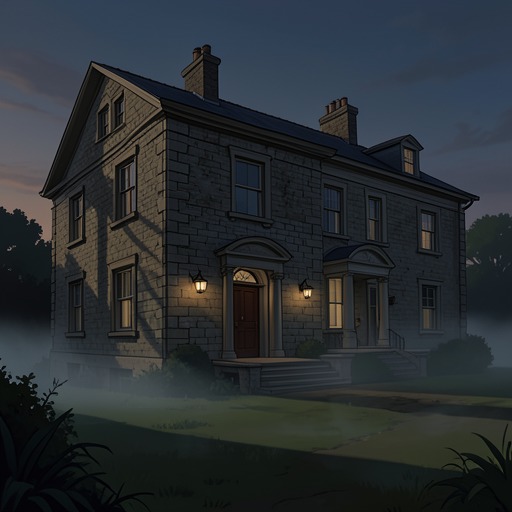
The Hidden StaircaseThe hidden staircase and underground passage is the concealed route between Nathan Gombet’s house and The Mansion, a piece of architecture that gives a physical explanation for the Turnbull sisters’ apparent haunting and the thefts from their home. Its discovery transforms Nancy Drew’s suspicion into proof: a hidden route lets an intruder move between the houses and emerge inside The Mansion without using its ordinary entrances. The passage is at once a practical mechanism in the mystery and the buried history that makes the deception possible.
Discovery and Construction
Nancy began searching Nathan Gombet’s house because she suspected a connection between it and The Mansion. She had learned that the two residences were built at approximately the same time and had already failed to find an entrance in The Mansion’s cellar. In Gombet’s basement, however, she found no opening: the walls appeared to be solid stone. The route was concealed not in the cellar but elsewhere in the house, so the initial search seemed to offer no confirmation of her theory.
The breakthrough came later in a closet. Nancy noticed a tiny knob, too small to serve any ordinary purpose, and twisted it. A click seemed to come from the mechanism; tapping the closet’s back wall revealed a hollow sound. When she pressed the knob with all her strength, a spring clicked and the entire side of the closet wall dropped away. The hidden entrance was therefore disguised as part of the closet rather than marked by a visible door or obvious opening.
The construction’s earlier history remains an explanation Nancy infers, not a fact she witnesses. She thinks the passage may have been built before the American Civil War as protection against marauders, when the Turnbull brothers were on friendly terms and could use it to travel between the houses. In her reconstruction, the brothers became enemies during the war, the passage was closed, and later generations forgot it. The book presents that account as a probable history of the structure; the decisive discovery is that the route still exists and connects the residences.
The Descent and Route
The entrance’s mechanism proved dangerous as well as concealed. When the wall opened, Nancy fell headlong down a steep flight of stone steps. The closet wall clapped back into place behind her, and she struck a hard object before reaching the bottom, losing consciousness. She awoke in darkness, hurt and disoriented, and could recall pressing the knob but not the fall itself. The secret architecture temporarily turned an investigation into a trap: the entrance hid itself again, leaving Nancy below ground with no immediate way to retrace her steps.
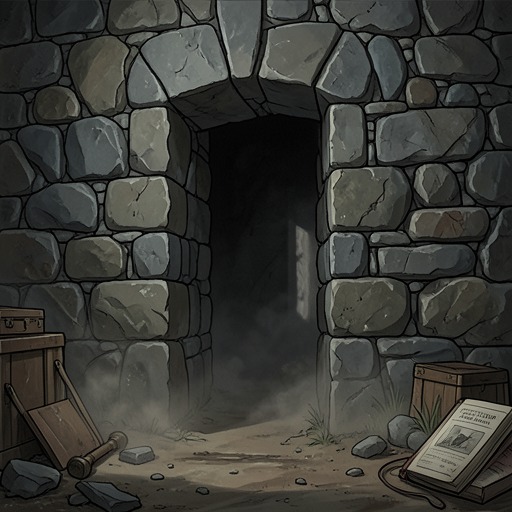
After recovering, Nancy climbed the stairs and found only a solid wall at their top; she could not locate the hidden spring from that side. Rather than spend valuable time searching for the release, she chose to follow the passage. The crudely cut stone steps led almost straight down into darkness, beyond which stretched the tunnel. She knew it might lead into danger, but continued, making the passage’s unknown destination part of the discovery rather than a reason to retreat.
The route eventually brought her into The Mansion. Nancy recognized an old highboy she had seen while searching the attic, and realized that the stairs she had ascended led up into that part of the house. She inferred that other flights she had passed might lead to other portions of the building, though their destinations were not yet established. The journey thus revealed more than a connection between two houses: it suggested a network of concealed access points within The Mansion.
Entrances Inside The Mansion
Nancy later showed Rosemary Turnbull and Floretta Turnbull the open trapdoor in the attic and explained that the staircase led to a tunnel connecting The Mansion with Nathan Gombet’s house. The sisters’ astonishment reflected how effectively the entrance had been hidden in their own home. The architecture had been present without forming part of their ordinary understanding of the house; Nancy’s discovery made a familiar attic newly legible as an access point.
Further exploration exposed a second kind of concealed entrance. With Rosemary holding a candle, Nancy examined an overhead panel and pushed until it lifted. She emerged through the seat of a sofa in the library, an opening that had been concealed beneath the furniture. She then found a similar opening beneath the sofa in the drawing room, large enough for a person to squeeze through. These discoveries showed that the underground route was not simply a tunnel with one endpoint in each house: its concealed openings gave access to rooms within The Mansion.
The sofa openings also clarified a particular theft. Floretta concluded that Nathan Gombet had stolen the silver urn by coming up through the library sofa. The sisters’ recognition of this route connected the secret architecture to a concrete loss, while Nancy’s discovery supplied the physical explanation for how an intruder could appear inside a room without passing through its visible doors. The book establishes the library and drawing-room openings; Nancy’s broader suggestion that other openings might exist on each floor remains an inference.
Role in the Mystery
The passage resolves the apparent supernatural mystery through an ordinary, if extraordinary, physical mechanism. Nancy had suspected Nathan Gombet because he wanted to buy The Mansion for a ridiculously low price and because she believed he had been visiting it at night. Suspicion alone had not been enough to take her case to the authorities. Once she found the connecting route and its concealed entrances, she understood how Gombet could enter, frighten the Turnbull sisters, and steal their valuables, and she believed she had obtained the proof she needed.
Architecturally, the mechanism depends on reversals between visible and hidden space: solid-looking walls conceal a spring-operated panel; a familiar sofa conceals an opening; and the attic, which Nancy had searched before, becomes an exit from the underground route. The house’s rooms are not only rooms but possible thresholds. This pattern makes the hidden passage central to both the solution and the suspense: the concealed spaces first make ordinary events seem inexplicable, then reveal how those events were engineered. The forgotten route also binds the mystery’s present action to a conjectured family history, so that the secret beneath the houses is both a means of access and an explanation for why that access had escaped notice for so long.